Consider a common scenario for a commercial property owner.
A tenant's lease says the tenant is responsible for:
Base Rent + Operating Costs + Annual Escalations + Additional Recoveries
The lease administration team has the information.
The accounting system has the tenant.
The property manager has the building.
But the information doesn't always stay synchronized.
A rent escalation may be buried in a 120-page lease.
A recovery provision may be interpreted differently from the accounting setup.
A critical date may sit in someone's spreadsheet.
And when the owner asks:
"Are we billing this tenant correctly?"
Someone has to manually investigate.
That investigation can take hours.
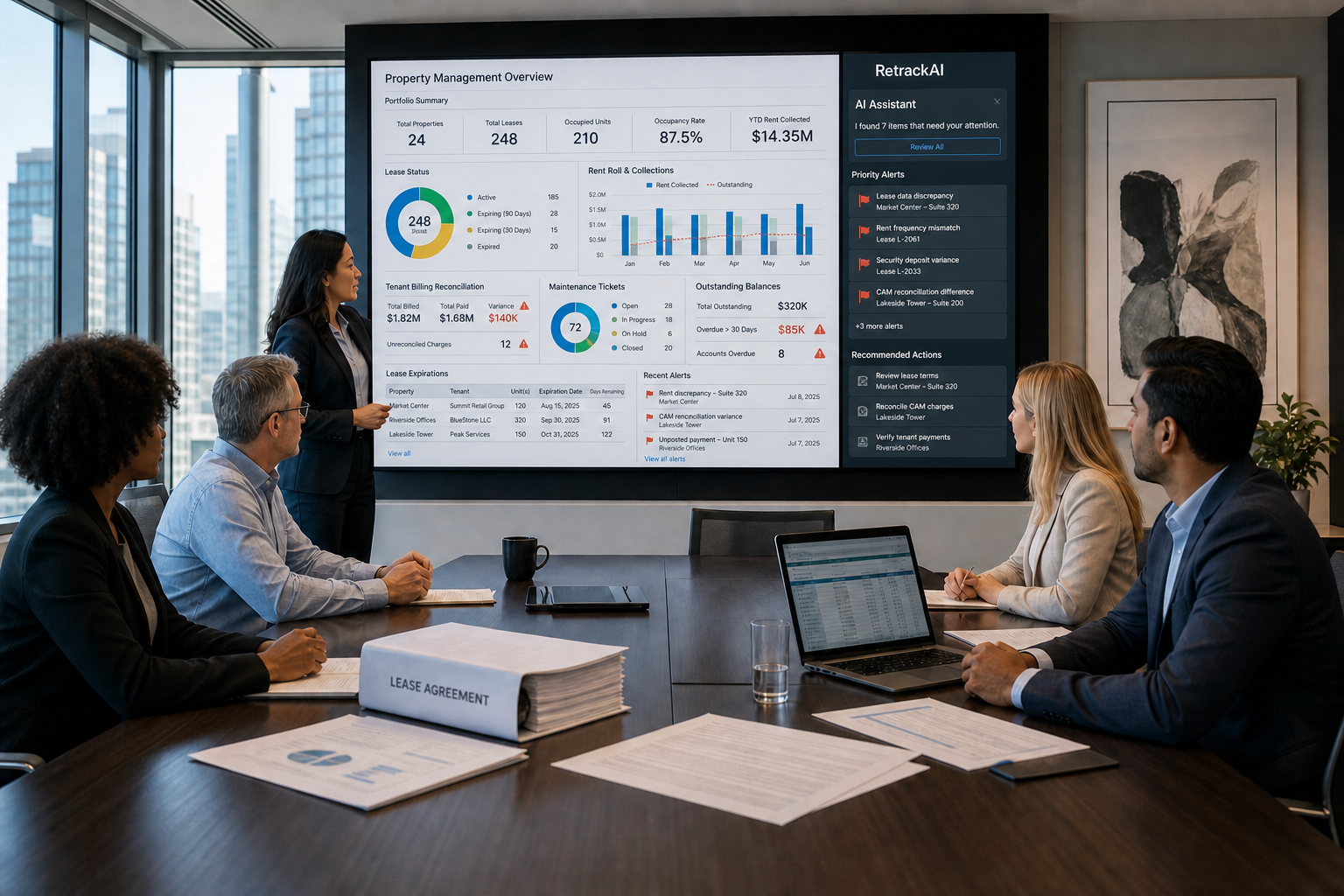
Now imagine RetrackAI doing the first pass.
RetrackAI reads the lease, identifies the applicable provisions, compares them against the structured lease data and accounting information, and flags the exception.
For example:
Lease says: 3% annual escalation
System reflects: 2%
RetrackAI: 🚨 Potential billing discrepancy
The AI doesn't simply say "something is wrong."
It can show:
Lease provision → Source citation → System value → Difference → Recommended action
A human can then review and approve the change.
Why this matters to owners
A small discrepancy across one lease may not matter.
Across 500, 1,000 or 10,000 leases, it becomes an entirely different problem.
It can mean:
- Lost recoveries
- Missed rent escalations
- Incorrect CAM billing
- Compliance exposure
- Hours of manual audit work
- Delayed reporting
- Poor visibility into portfolio performance
The opportunity isn't just automating lease abstraction.
It's continuously asking:
"What in my portfolio doesn't look right?"
And then bringing the exception to the right person.